Andrew Wilson's Doublethink Masterclass
From the archive — published in 2018 on the original Chokkablog, kept as it was written.
I'll keep this brief.I've just caught up with Andrew Wilson's Sunday Politics Scotland interview from 27/05/2018. If you want to hear the words I'm taking issue with being spoken, watch here from 7:30

Verbatim, emphases mine:
"well in fact, we do the opposite of what the OBR and George Osborne has done because we don't put assumptions for growth into the numbers - we could have just said 'well we've modeled it, we think growth's going to be faster and look here, everything's fine' ... [interviewer interruption] .. well, we assume that over time the average performance of the past is the average performance of the future for inflation and growth, and we say 'what would you do?' - now the point of this Gordon if I may say is, that without making wild predictions for growth we show how over a period of 5 to 10 years - while growing the public finances, rejecting austerity, stewarding growth at the same time - we can bring discipline to the public finances sustainably."You might want to watch the clip to believe that's what he said, but it is - and it's consistent with his comment to me on Twitter that "there is no growth rate assumption".
So let's quickly unpick the bizarre logic of the first half of this extract before turning to the assertion in the second half.
He states "we don't put assumptions for growth into the numbers" before then describing the assumptions for growth they put into the numbers: "we assume that over time the average performance of the past is the average performance of the future for inflation and growth".
So they do put assumptions for growth into the numbers - which is obvious because without assumptions for growth they couldn't make the assertion he then goes on to make.
We know this anyway because the report is explicit about the assumption used to drive the analysis that AW refers to when he says "we show how over a period of 5 to 10 years [..] we can bring discipline to the public finances sustainably". He's referring to the analysis behind this graph (note how 9 years has become "5 to 10 years");

It's genuinely baffling to me that AW would say "we don't put assumptions for growth into the numbers" when the assumptions that are required to support the assertion he goes on to make are explicitly laid out in the report itself

[These aren't always easy to read: B12.18 makes explicit a 1.5% pa real GDP growth assumption]
I've been through detailed analysis of this in other blogs (eg. here) but in essence the sums are really simple (and by the way don't require any inflation assumptions at all, presumably they're in there just to allow better sounding nominal figures to be quoted).
You only need a three row spreadsheet to show that if you grow Spend 1% slower than GDP then - all other things being equal - a 5.9% deficit would indeed become less than a 3% deficit after 9 years (because spend/GDP necessarily declines). If you like, here's that in graph form and in the context of historical actuals and the various deficit figures you will see quoted in the report (more detail here)

By rights we should show this graph based on onshore GDP only, although it doesn't materially change the conclusion
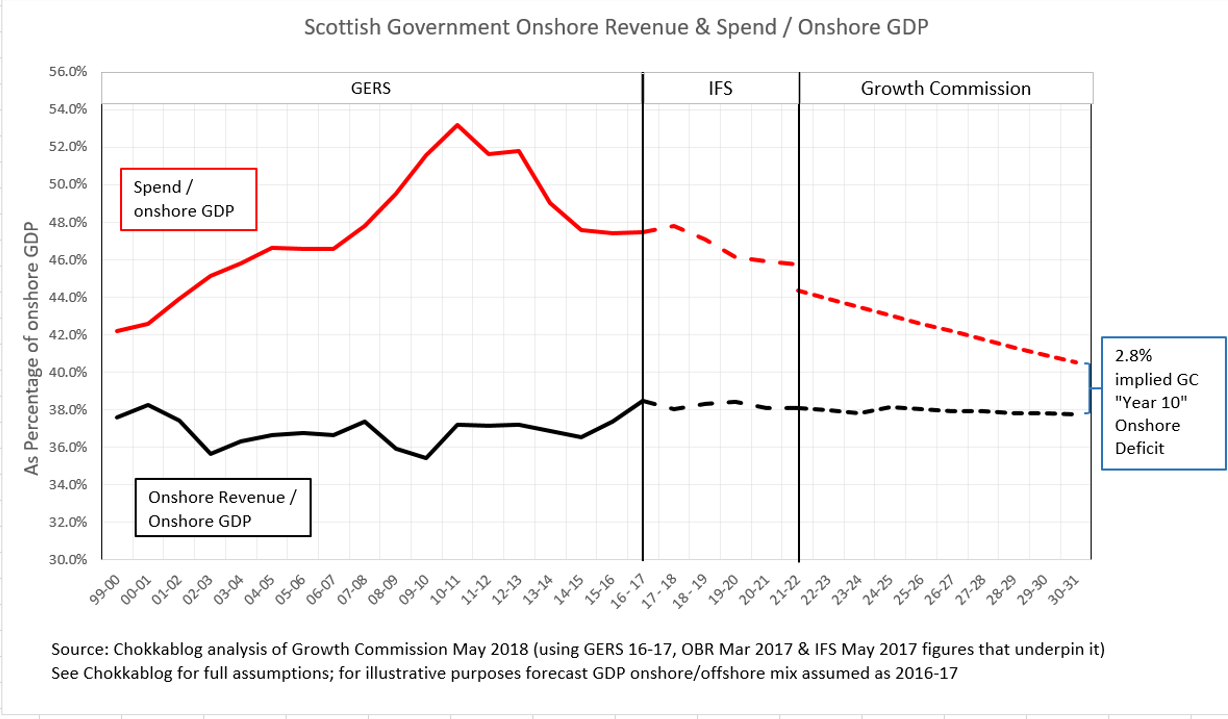
OK, so we know that in fact AW has made an assumption for growth to make his statement stack up. 1.5% assumed real GDP growth means that, if spending growth is 1% less, then that's 0.5% real spending growth - which allows AW the soundbite of "growing the public finances, rejecting austerity" because real spending is increasing.
In that clearly well-rehearsed sound-bite he also says "stewarding growth at the same time" - I think maybe he should have said assuming higher growth at the same time.
So he's made a growth assumption and it's a really important one - if that assumption was less than 1.0% then he'd be advocating real spending cuts to "bring discipline to the public finances sustainably".
So let's look at some actual real GDP growth rates
- Over the "austerity decade" from 2006-07 up to 2016-17, Scottish onshore GDP showed average real growth of just 0.8% pa
- The latest forecast from the Scottish Fiscal Commission (published 31/05/2018) is for GDP growth in 2023 to be running at 0.9% pa
Hold on. If real GDP growth is less than 1.0% then applying AW's fiscal rule of getting the deficit down to below 3% within 10 years would require public spending cuts - would require austerity far and above anything we've seen while being in the UK, as this simple graph illustrates;

Now to be fair, it's true that if you go back long enough (I reckon 14 years) then you can get to an historic average real onshore GDP growth rate of 1.5% - but that takes you back to when the economy was booming. Making assertions about how you would "reject austerity" if the economic conditions were such that even George Osborne would not be suggesting austerity is hardly a meaningful contribution to the debate.
What matters is what you do when times are harder than average, when real GDP growth is less than 1.0%. Andrew Wilson works hard to be distinctly unclear about this (as did Commission member MSP Kate Forbes on Question Time) , but the Growth Commission report is clear for those who can be bothered to read it: if GDP growth was as sluggish as it has been for the last decade or as slow as the Fiscal Commission forecast, the Commission recommends embracing austerity as enthusiastically as any Tory chancellor.
* Addendum *

Verbatim, emphases mine:
"I've got some analysis here which I'm going to share with the chamber, and hopefully it'll be ... it'll be of embarrassment to the Tories, hopefully it'll be of interest to Labour. If the spending recommendations of the Growth Commission had been applied over the past ten years, the £2.6bn real-terms cuts imposed on the budget of the Scottish government by Tory governments at Westminster would have been completely wiped out, it would have eradicated austerity in Scotland. That is the reality"
Anybody who has read this post or indeed my post on similar claims made by SNP MSP Kate Forbes on Question Time will know that that very much is not "the reality" - that is in fact a big steaming pile of horseshit.
* Addendum 2 *

Anybody who has read the report and/or who has followed my recent blogs and/or who has thought about what applying the report's deficit reduction "model" would mean will know that this isn't spin, it isn't doublethink - it's an out and out lie.