The SNP's Conversion
From the archive — published in 2018 on the original Chokkablog, kept as it was written.
Yesterday the SNP published "Scotland's Place in Europe". It's a good piece of work and a worthwhile read for anybody who wants to gain an understanding of the (UK wide) issues surrounding Brexit and the various options we face.But if we allow ourselves to step back from the Brexit question for a moment, it's interesting to read the report while considering the SNP's continued commitment to drag Scotland out of the UK Single Market. A couple of observations;
Firstly, the report is admirably thorough but with one major exception: it simply ignores Scotland's exports to the rest of the UK (rUK) when scaling the economic issues. Given we're looking at the Scottish Economy here, we should surely scale figures in the context of total Scottish exports, not just "international exports" (a term they use to allow them to ignore exports to rUK completely). Let's take a quote from the report and correct it;
"24. The EU is Scotland’s second most important[Notice by the way that these figures come from the Scottish Government's Export Statistics Scotland publication, a report that nationalists decry as wholly unreliable when they don't want to face the reality of what the figures show]internationalexport market. In 2015, Scottish companies’ exports to countries within the EU were estimated at £12.3 billion, which is43%16% of Scotland’s totalinternationalexports and supports, directly and indirectly, hundreds of thousands of jobs across Scotland."
Let's take another example - note they no longer even bother with the "international exports" qualifier here;
"38. To replace a 5% reduction in Scotland’s EU exports with increased trade from the BRICS economies would require a 30% increase in exports to those economies. Even if the UK signed agreements with the 10 biggest non-EEA single country trading partners (including USA, China, and Canada), a process which would take many years, this would only coverOf course we could also rewrite that quote thinking from the perspective of Scotland leaving a post-Brexit the UK;37%14% of Scotland’s current exports compared to43%16% of current exports that go to the EU"
"38. To replace a 5% reduction in Scotland’sLet's do one more - but first we need to highlight an apparent error in the base figures;EUUK exports with increased trade fromthe BRICS economiesthe EU would require a30%20% increase in exports to those economies. This within the context that our current levels of EU trade have been achieved after almost 45 years of unfettered market access."
"90. Similarly, in relation to the agriculture and forestry sectors, Brexit represents a hugely significant challenge. Food and drink alone accounts for Scotland’s biggest non-energy export, with over two-thirds of exports worth £1.2 billion in the first three quarters of 2017 going to EU countries."There is no source given for the "two-thirds of exports" assertion (the next sentence references this report which doesn't seem to give that figure, unless I've missed it?). The most recent ESS data (for 2015) gives a full year figure for Food & Drink exports to EU of £1.8 billion (so would seem consistent with the above, given that's a "first three quarters" number), but that's 38% (over one-third, not over two-thirds) of "International Exports" of £4.8bn and just 20% of all exports (when rUK exports is included) of £8.9bn. So the corrected version would read;
"90. Similarly, in relation to the agriculture and forestry sectors, Brexit represents a hugely significant challenge. Food and drink alone accounts for Scotland’s biggest non-energy export, withOK, so they ignore exports to rUK when scaling the export figures (and they may have made a "two-thirds" instead of "one-third" typo) ... but assuming Scotland remains in the UK with unfettered market access this approach could be defended, albeit I would suggest it's presented in an intentionally misleading way.over two-thirdsless than one third of exportsworth £1.2 billion in the first three quarters of 2017going to EU countries."
The second observation is that the SNP suddenly seem very happy to believe economic forecasts from HM Treasury, the National Institute for Economic & Social Research (NIESR) and Fraser of Allander. They are variously cited throughout the document and their forecasts summarised in this handy table at the back

Anybody familiar with the indyref debate must surely be raising their eyebrows at this point. Notice how the Scot Gov forecasts are at the most pessimistic end of the spectrum - "Project Fear" anyone?
Now let's just remind ourselves of the attitude shown to HM Treasury forecasts when they related to the outlook for an independent Scotland;
- Here's Alex Salmond referring to The Treasury's figures - which were using what turned out to be extremely optimistic Office for Budget Responsibility (OBR) forecasts:
"But the First Minister dismissed the OBR’s figures as “stuff and nonsense”. A spokesman for the First Minister said: “Danny Alexander must apologise for the Treasury’s dodgy dossier on the finances of an independent Scotland" - When HM Treasury analysis suggested the one-off costs of setting up the institutions for an independent Scotland would be £1.5 - 2.7bn, Salmond called it a "highly misleading briefing". He suggested the true figure would be nearer £0.2bn, a figure which was obviously fantastical at the time. Later that same year the Centre for Economics and Business Research (CEBR) published a report which concluded: "The set up costs for an independent Scotland would run to nearly £2.5bn"

"on the basis of any reasonable division of existing assets and liabilities, Scotland would begin its independence with a substantial debt burden and less scope for risk-sharing. We estimate that Scotland would need to run primary surpluses of 3.1% annually order to achieve a Maastricht defined debt to GDP ratio of 60% after 10 years of independence. This would be more restrictive than the fiscal tightening over the last four years."Finally for now, within the Scotland's Place in Europe report the Fraser of Allander Institute (FAI) is quoted in relation to the jobs threat from Brexit;
"The FAI have also presented the impact on jobs, suggesting Brexit could cost up to 80,000 jobs."That's the same Fraser of Allander Institute who have suggested that more than four times as many jobs are supported by rUK exports as by rEU exports.
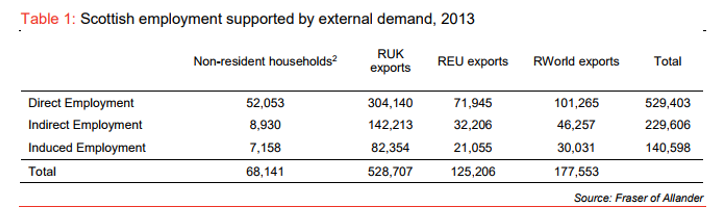
It will be interesting to see how the SNP respond to HM Treasury and other respected institutions' analyses and forecasts if their fabled indyref2 ever occurs.